Most lifters pick their working weights by feel or by following a fixed percentage from a spreadsheet. Both approaches have blind spots. A bad night of sleep can turn a routine set into a grinder, while a great day in the gym goes wasted if the program says “stay at 75%.”
The RPE calculator on this page solves that problem. Enter your recent set data, and the tool instantly generates an estimated one-rep max (e1RM) along with a live chart of recommended loads for every rep and RPE combination. Instead of guessing, you get numbers tied to how your body actually performs today.
Contents:
Rate of Perceived Exertion (RPE) is a method that assigns a numerical value to how hard a set feels during exercise. In strength training, this number reflects internal effort rather than external load.
The system gives lifters and coaches a shared language for describing workout intensity without relying solely on bar weight or fixed percentages.
Subjective effort measurement means rating your own exertion based on physical cues your body sends during a set. These cues include breathing rate, muscle fatigue, heart rate elevation, and the speed at which the bar moves.
A set that makes you breathe hard, slows the bar to a crawl, and leaves your muscles shaking rates higher than a set where the weight moves fast and your breathing stays controlled.
This internal feedback loop is the foundation of every RPE-based scale. The lifter checks in with their body after (or during) a set and assigns a number that captures the total difficulty of the effort.
Over time, consistent self-assessment builds a reliable internal gauge that improves workout-to-workout decision making in the gym.
No heart rate monitor or velocity tracker is required. Your own perception, when practiced honestly, becomes a precise tool for regulating training intensity.
Swedish researcher Gunnar Borg created the original perceived exertion scale in the 1960s. His 6-to-20 scale was designed to correlate with heart rate during aerobic exercise and quickly became a standard in clinical and sports physiology settings.
Decades later, powerlifting coach Mike Tuchscherer adapted the concept for the weightlifting community through his Reactive Training Systems (RTS) methodology.
Tuchscherer replaced the broad 6-to-20 range with a focused 1-to-10 scale tied directly to Reps in Reserve (RIR), the number of additional reps a lifter could complete before muscular failure. This adaptation made the scale practical for barbell training, where the difference between one rep left and zero reps left has a major impact on fatigue and recovery.
Today, the RIR-based RPE scale is the default intensity tool in competitive powerlifting and evidence-based strength coaching.
Autoregulation means adjusting training loads in real time based on how your body performs on a given day, rather than following a rigid plan. RPE is the primary tool for autoregulation in the gym because it captures daily readiness without extra equipment or testing.
Multiple factors influence daily readiness:
On a good day, a lifter might hit a prescribed weight at RPE 7 and have room to add load. On a bad day, the same weight might register RPE 9 or higher.
RPE-based programming accounts for both situations. The lifter hits the target effort level regardless of what the bar weighs, which keeps training productive without crossing into excessive fatigue.
Three distinct scales exist for rating exercise intensity. Each one serves a different context.
Understanding all three prevents confusion when reading research or following a new program.
Gunnar Borg designed the 6-to-20 scale with a simple mathematical principle. Multiply the scale value by 10, and you get an approximate heart rate in beats per minute for a healthy adult.
| Borg Score | Perceived Effort | Estimated Heart Rate (BPM) |
|---|---|---|
| 6 | No exertion at all | ~60 |
| 9 | Very light | ~90 |
| 11 | Fairly light | ~110 |
| 13 | Somewhat hard | ~130 |
| 15 | Hard | ~150 |
| 17 | Very hard | ~170 |
| 19 | Extremely hard | ~190 |
| 20 | Maximum exertion | ~200 |
This scale is most useful for aerobic exercise, where heart rate is a direct indicator of intensity. Clinicians still use it during treadmill stress tests and cardiac rehabilitation protocols.
For barbell training, the 6-to-20 range is too broad. A set of 5 heavy squats and a set of 3 heavy squats might both land around “17, very hard,” but those two efforts demand different recovery strategies.
The 1-to-10 RIR-based RPE scale is the standard in the lifting community. Each number on the scale corresponds to how many reps the lifter could still perform before hitting muscular failure.
| RPE | Reps in Reserve (RIR) | Description |
|---|---|---|
| 10 | 0 | Maximum effort, no reps left |
| 9.5 | 0 | Max effort, but could possibly add slight load |
| 9 | 1 | Could do 1 more rep |
| 8.5 | 1-2 | Could definitely do 1, maybe 2 more reps |
| 8 | 2 | Could do 2 more reps |
| 7.5 | 2-3 | Could definitely do 2, maybe 3 more reps |
| 7 | 3 | Could do 3 more reps |
| 6.5 | 3-4 | Could definitely do 3, maybe 4 more reps |
| 6 | 4 | Could do 4 more reps |
Half-point increments (like 8.5 or 7.5) give lifters more precision when a set falls between two whole numbers.
This scale works only when the lifter has enough training experience to recognize the physical sensation of being 1, 2, or 3 reps from failure.
The modified Borg Category-Ratio 10 (CR10) scale rates exertion from 0 (rest) to 10 (maximum effort). It uses breathing rate and general fatigue as the primary indicators rather than counting reps in reserve.
| CR10 Rating | Perceived Effort |
|---|---|
| 0 | No exertion, at rest |
| 1 | Very light |
| 2-3 | Light |
| 4-5 | Moderate |
| 6-7 | Vigorous |
| 8-9 | Very hard |
| 10 | Maximum effort |
The CR10 scale looks similar to the 1-to-10 RIR scale, but the two measure different things. CR10 reflects overall breathlessness and systemic fatigue. The RIR scale measures how close a set is to muscular failure on a specific exercise.
A set of 20 lightweight lunges might rate CR10 8 because of heavy breathing, yet rate RPE 6 on the RIR scale because many more reps are still possible.
For weightlifting and bodybuilding, the RIR-based RPE scale provides more actionable data. The CR10 scale fits better in group fitness, circuit training, and general conditioning contexts.
The RPE calculator on this page converts your recent lifting performance into a complete load prescription across multiple rep ranges. It has three input fields, a result panel, and a live matrix that updates instantly.
The core function of the calculator is estimating your one-repetition maximum (e1RM) from submaximal data. You enter three values:
The calculator uses established load-rep-RPE percentage tables to work backward from these inputs.
For example, entering 220 lbs for 5 reps at RPE 8 tells the calculator that 220 lbs represents roughly 81.1% of your maximum. Dividing 220 by 0.811 gives an e1RM of approximately 271.3 lbs.
The result panel displays both the e1RM value and the percentage of 1RM that your entered set represents.
Real gym plates come in fixed sizes. Barbells cannot be loaded to 217.3 lbs unless you have fractional plates available.
The “Minimum weight increment” dropdown addresses this by rounding every calculated weight to the nearest practical increment.
The available options are:
Selecting 2.5 as the increment means every weight in the matrix rounds to the nearest multiple of 2.5.
This ensures you never see a number on screen that you cannot actually load onto a barbell.
For lifters using kilogram plates, setting the increment to 1 or 2.5 matches common European gym equipment.
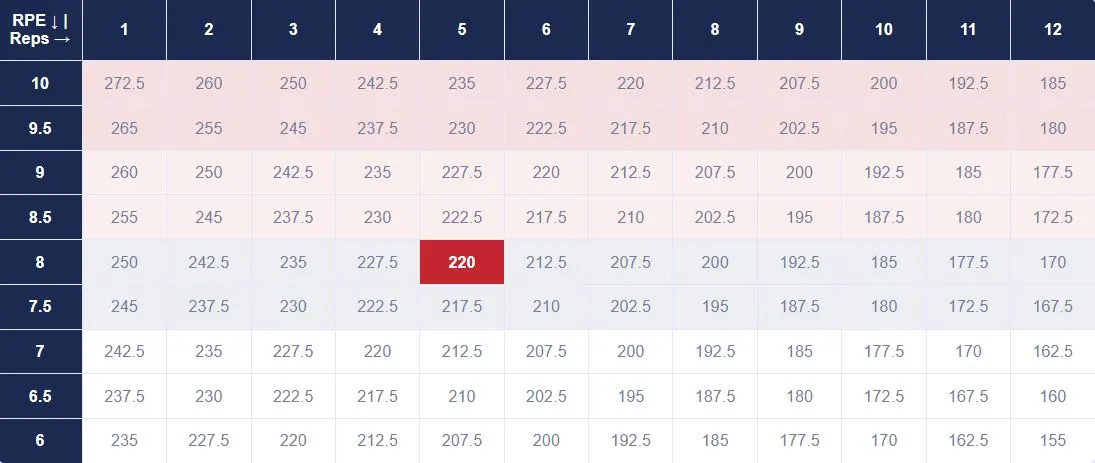
The right side of the calculator displays a live chart that cross-references rep counts (1 through 12) against RPE values (6 through 10).
Once you enter your weight, reps, and RPE, every cell in this matrix fills with a specific load recommendation.
Find your target RPE on the left column, find your target rep count on the top row, and the intersecting cell shows the recommended weight.
The chart updates instantly when you change any input value, so you can test different scenarios before stepping under the bar.
RPE works differently depending on the sport, rep range, and training goal.
A powerlifter preparing for a meet uses RPE in a fundamentally different way than a bodybuilder chasing hypertrophy or a casual gym member trying to stay in shape.
The sections below break down RPE targets and strategies for each context.
Powerlifting revolves around low-rep, high-load training on the squat, bench press, and deadlift. Most working sets fall in the 1-to-5 rep range, and the goal is building absolute strength while managing fatigue for a competition peak.
Optimal RPE targets for powerlifting:
Staying below RPE 10 on regular training days preserves technique quality.
Bodybuilding prioritizes muscle growth through higher rep ranges (typically 6 to 12+ reps) and training close to muscular failure.
According to a 2024 meta-regression by Robinson et al., muscle hypertrophy increases as sets are terminated closer to muscular failure, supporting RPE 8 to 10 (0 to 2 RIR) as the effective training zone for muscle growth.
For compound lifts like squats and bench press, RPE 8 to 9 is a practical ceiling. Going to RPE 10 on multi-joint movements carries high injury risk and generates excessive systemic fatigue.
For isolation exercises like bicep curls, lateral raises, or leg extensions, RPE 9 to 10 is safer because the loads are lighter and the risk of catastrophic form breakdown is low.
A typical bodybuilding session might look like this:
This approach ensures every muscle group receives enough stimulus for growth without draining overall recovery capacity.
The Talk Test is a simple method for gauging aerobic exercise intensity using the ability to hold a conversation. It maps directly onto the RPE scale:
| Intensity Level | Talk Test Result | RPE (0-10 CR10 Scale) |
|---|---|---|
| Low | Can speak comfortably in full sentences | 3-4 |
| Moderate | Can talk but with some effort | 5-6 |
| High | Can only say a few words at a time | 7-8 |
| Maximum | Cannot speak at all | 9-10 |
For general fitness and cardiovascular health, most sessions should fall in the moderate range (RPE 5 to 6).
Interval training pushes into the high range (RPE 8 to 9) for short bursts, followed by recovery periods at RPE 3 to 4.
This combination builds aerobic and anaerobic capacity without overtraining.
New lifters face a specific challenge with RPE. They have not yet developed the neuromuscular awareness to accurately gauge how many reps they have left before failure.
Most beginners overestimate their RPE, rating a set at “9” when a more experienced lifter would call it a “7.”
For beginners, the recommended approach is:
Conservative RPE targets let new lifters build the mind-muscle connection, develop movement skill, and accumulate training volume without excessive soreness or injury risk.
As experience grows, the lifter can trust their internal RPE gauge more and train closer to failure.
How does an RPE calculator determine appropriate working weights?
The calculator takes your weight, rep count, and RPE rating, converts them into an estimated one-rep max (e1RM) using standard load-percentage tables, then works outward to calculate recommended weights for all rep and RPE combinations.
What is the optimal perceived exertion level for muscle hypertrophy?
RPE 8 to 10 is the recommended range for hypertrophy training. This corresponds to 0 to 2 reps in reserve, which provides enough proximity to muscular failure to drive muscle growth through mechanical tension.
How often should an athlete test actual one rep max instead of estimating?
Testing a true 1RM is best reserved for the end of a training block or before a competition. A frequency of once every 12 to 16 weeks keeps testing meaningful while minimizing injury risk from maximal attempts.
Can beginners accurately assess their reps in reserve?
Most beginners struggle with accurate RIR estimation. New lifters tend to overestimate difficulty and believe they are closer to failure than they actually are. Accuracy improves with 3 to 6 months of consistent training and honest self-assessment practice.
Why does rated perceived exertion fluctuate for identical loads across different days?
Sleep quality, psychological stress, nutrition, hydration, and residual fatigue from prior sessions all change how a given weight feels. The same 100 kg squat can register RPE 7 on a rested day and RPE 9 after a poor night of sleep.
How do reps in reserve differ functionally from rated perceived exertion?
RIR is an objective count of how many additional reps you could complete before failure. RPE is a broader subjective rating of overall set difficulty. In the 1-to-10 lifting scale, they are inversely linked (RPE 8 = 2 RIR), but RPE can also capture factors like joint discomfort or cardiovascular strain that RIR does not reflect.
What role does the Borg scale play in medical exercise stress tests?
Cardiologists and exercise physiologists use the original Borg 6-to-20 scale during treadmill stress tests and cardiac rehabilitation programs. Patients rate their perceived exertion at each stage of the test, which helps clinicians assess heart and lung function, set safe exercise intensity limits, and monitor recovery after cardiac events.
 Add live graphics


 Loading...